
Focus Markets Review
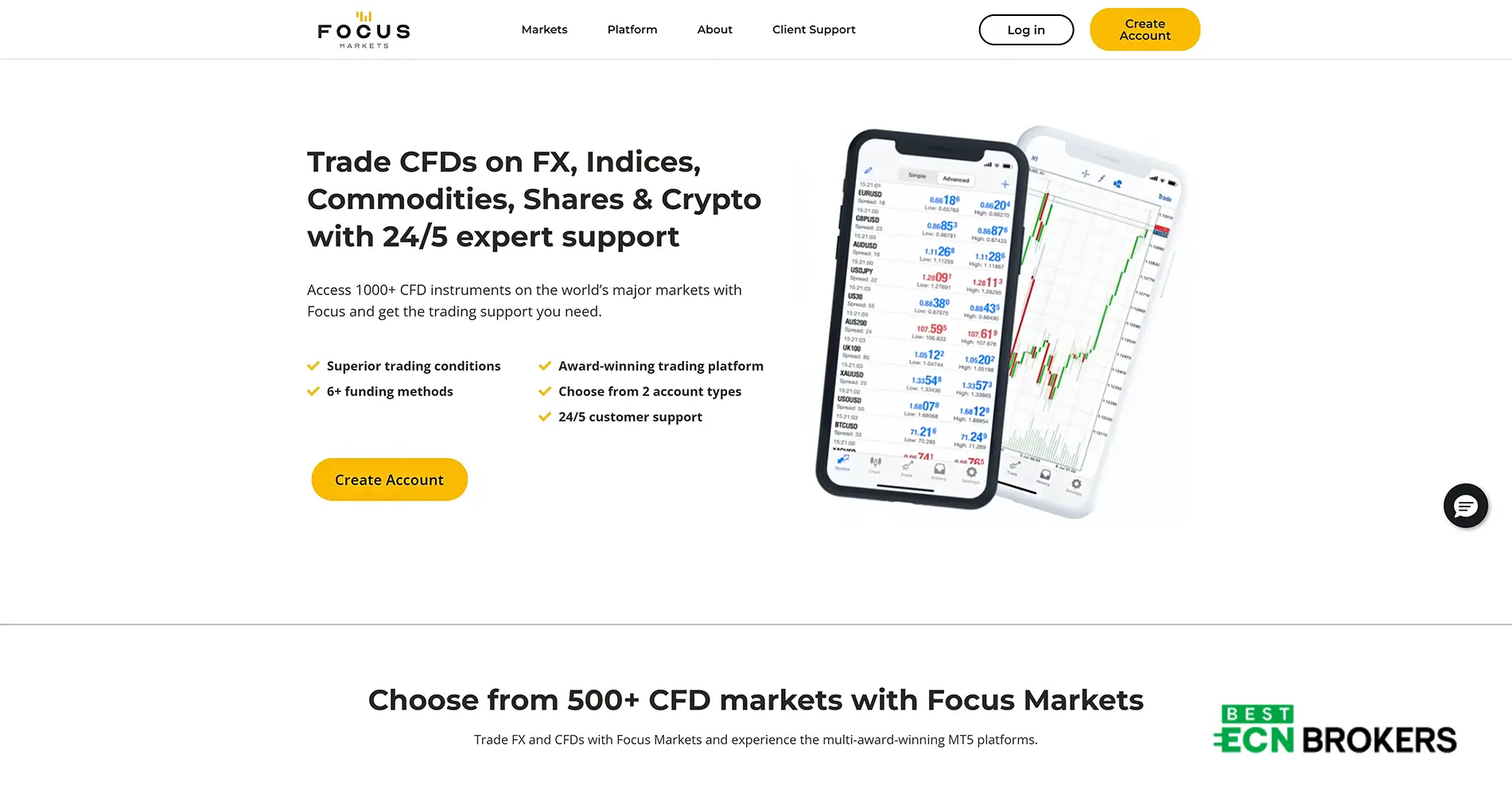
Focus Markets is a forex and CFD broker that started its journey in Melbourne, Australia in 2019. It has grown into a company that serves clients around the world, giving access to currencies, shares, indices, commodities, and even crypto. The idea behind the broker is simple: keep trading conditions clear, pricing competitive, and the platform easy to use. Traders today are often looking for a balance between safety and opportunity, and Focus Markets tries to place itself in that space.
Clients can trade more than a thousand instruments all from one account, and everything runs on MetaTrader 5, the only platform supported. MT5 is popular because it is quick, offers detailed charting, and works well across devices. With segregated funds and standard protections in place, the company presents itself as a broker that wants to appeal to both newcomers testing the waters and professionals who need tighter conditions.
Regulation and Safety of Funds

Focus Markets has a strong and flexible regulatory environment. The broker is licensed by the Australian Securities and Investments Commission (ASIC), which is considered one of the most authoritarian regulators in the financial industry. Because Focus Markets is regulated by ASIC they have rules about how they handle client funds, reporting obligations, and even how they conduct their business. For traders, this adds a layer of trust because it reduces the risk of dealing with an unregulated or loosely monitored company.
Alongside ASIC, the broker is also registered with the Vanuatu Financial Services Commission (VFSC). Although VFSC is not as highly rated as regulatory agencies in Europe or the UK, it allows Focus Markets to offer global services and maintain a flexible business model. The two-entity structure provides the broker with both credibility, and global scope, while allowing the broker to have a larger product offering and competitive account conditions for a wider audience.
When it comes to fund safety, Focus Markets follows common industry protections. They have strong policies; all client money must be held in segregated bank accounts, separate from the company’s own operational funds so that deposits cannot be misappropriated. Further, traders have negative balance protection so that they cannot lose more than their deposit even during rapid and volatile market moves.
What the broker does not currently provide is an investor compensation scheme, something you would find with brokers regulated in the UK or Europe. For some, that might be a drawback. However, the combination of ASIC regulation, segregation of funds, and risk protections still gives Focus Markets a reliable framework for most retail and professional traders.
Account Types and Minimum Deposits
Focus Markets keeps things simple with only two live account types. The first account is a Standard Account, which is designed for beginners or casual traders. Costs are included in the spread, and there are no commission fees. Here, spreads typically begin at one pip. The minimum deposit is low, so you don’t need a big balance to get started. For someone testing the platform or trading part-time, this account is enough.
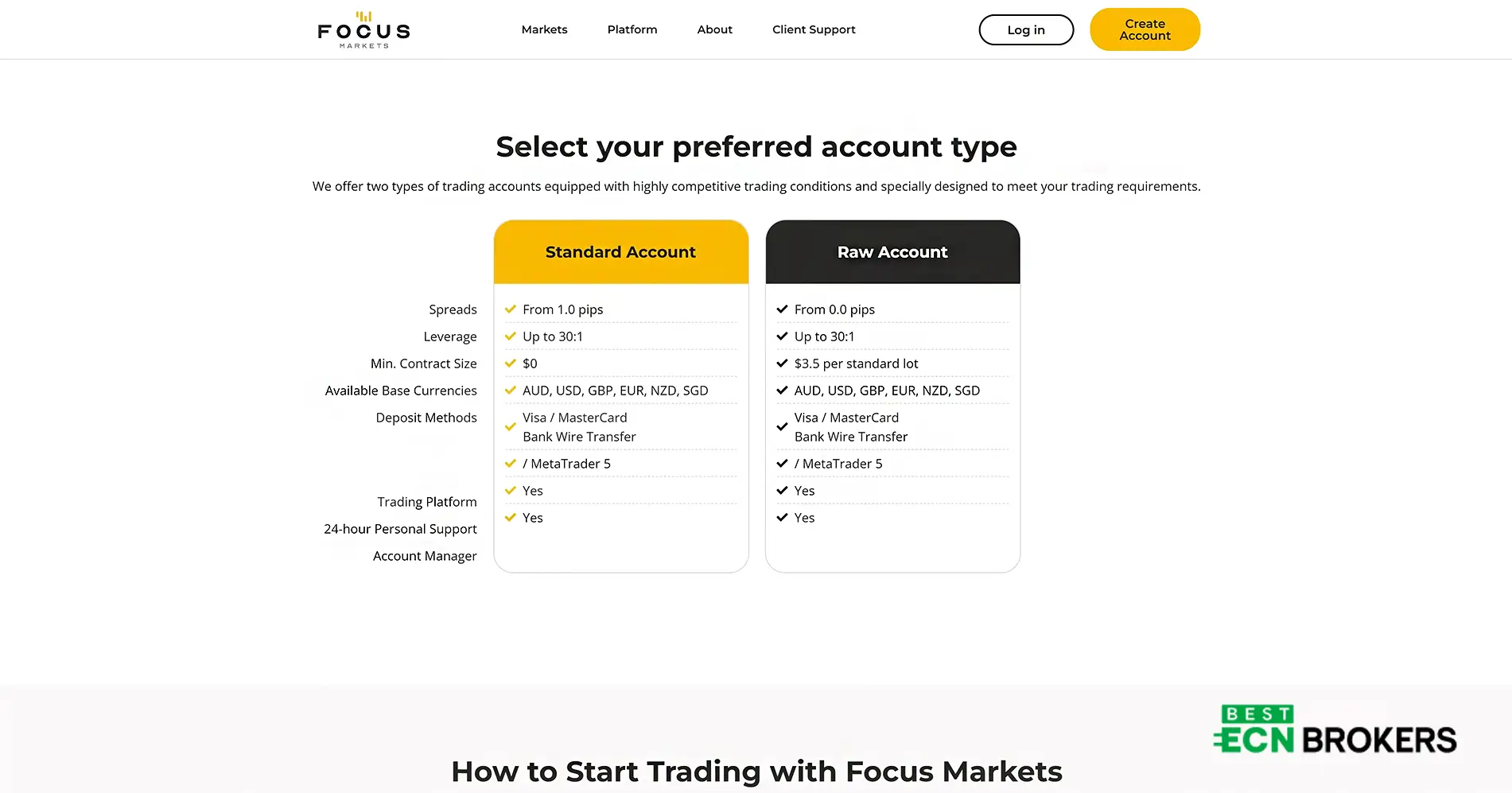
The Raw Account is option two. This is meant for active traders looking for fast pricing and tight spreads. Spreads may be very near to zero, but you pay a small commission for every trade. For certain strategies like scalping or high-volume trading, the Raw Account is often less expensive in the long-term. Execution is where things normally happen quickly, particularly if you’re using automated systems, or trading in volatile markets.
Leverage depends on where you are based, as ASIC and VFSC have different rules. Funding and withdrawals can be done through several methods, including bank transfers and digital wallets, and the broker itself does not charge extra fees for most payments.
In short, Focus Markets doesn’t overcomplicate the process. One account is for simplicity, the other for sharper costs. Traders just have to pick which fits their style.
Trading Platforms and Technology
Focus Markets doesn’t give you a choice between platforms. Everything runs on MetaTrader 5 (MT5). That might disappoint traders who are still attached to MT4, but in truth MT5 is the stronger platform. It has more charting tools, extra timeframes, faster backtesting, and a proper depth of market display. It’s also more stable for automated strategies.
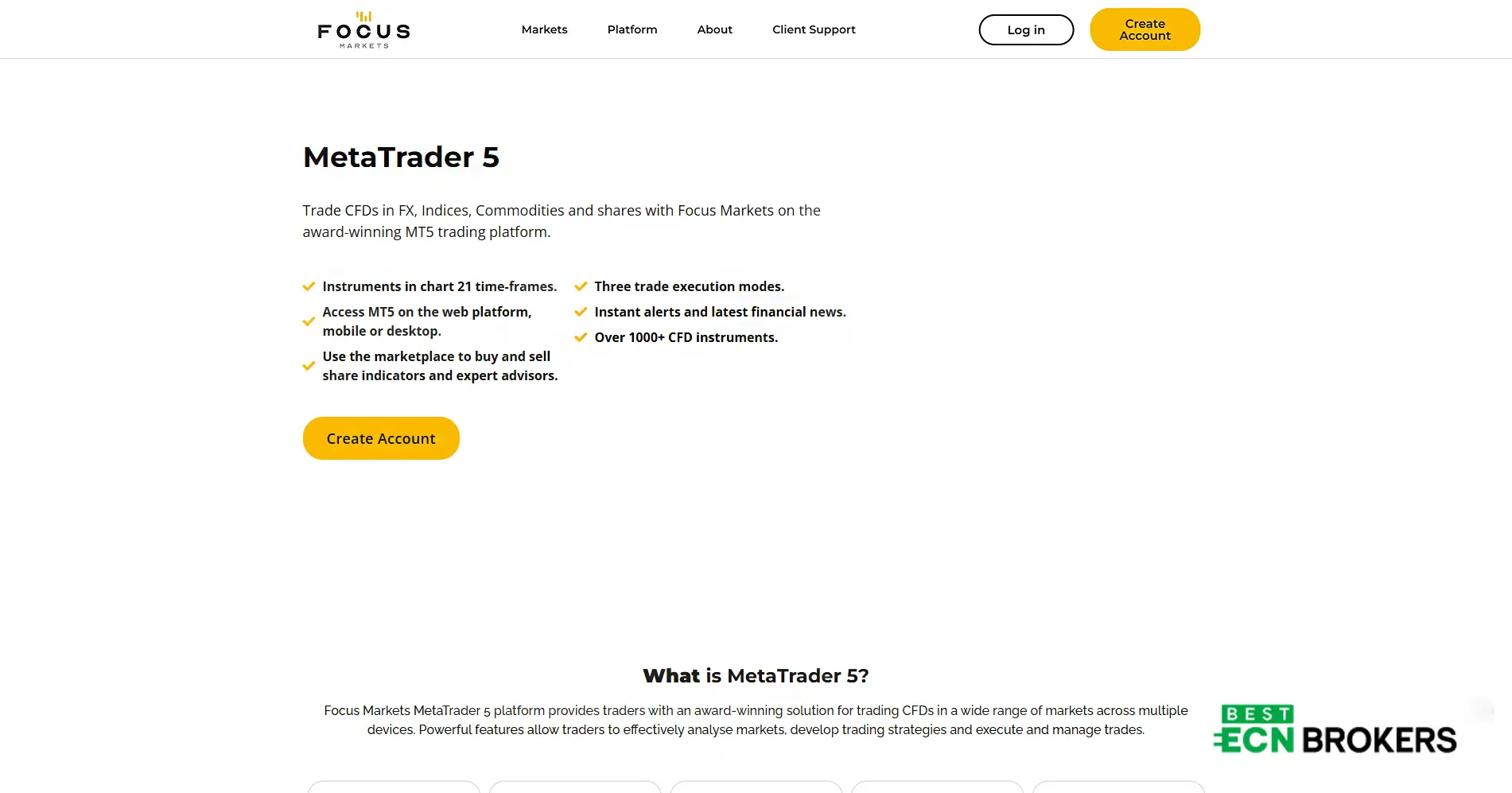
You can use MT5 on desktop, in the browser, or on mobile. The desktop version is the most powerful, with all the features and customization options. The web version is basic but useful if you just want to check positions quickly. The mobile app is simple, you can open and close trades easily and keep an eye on charts when you’re away from your desk.
Execution on Focus Markets is fairly quick. On the Raw account, spreads can get very tight, which is good news for scalpers. EAs also run fine, so traders who rely on automation won’t run into problems.
Nothing fancy here. No proprietary platform or add-ons. Just MT5, and that’s both the strength and limitation. If you’re comfortable with MT5, the setup works smoothly.
Pros / Cons
- Regulated by ASIC, which is a tough and trusted regulator.
- Also holds a VFSC license, so it can serve clients outside Australia.
- Raw account spreads can get very tight, good for scalpers.
- Decent choice of markets — forex, stocks, indices, commodities, and some crypto.
- MT5 is stable and easy to use across desktop, web, and mobile.
- Learning material is basic. If you want deep education, you’ll need outside sources.
- Customer support doesn’t run 24/7. If you trade odd hours, you might have to wait.
- No investor compensation scheme, unlike brokers in the UK or EU.
Trading Instruments Available
One of the main selling points of Focus Markets is the range of products you can trade. The broker gives access to more than a thousand instruments, which is more than enough for most retail traders.
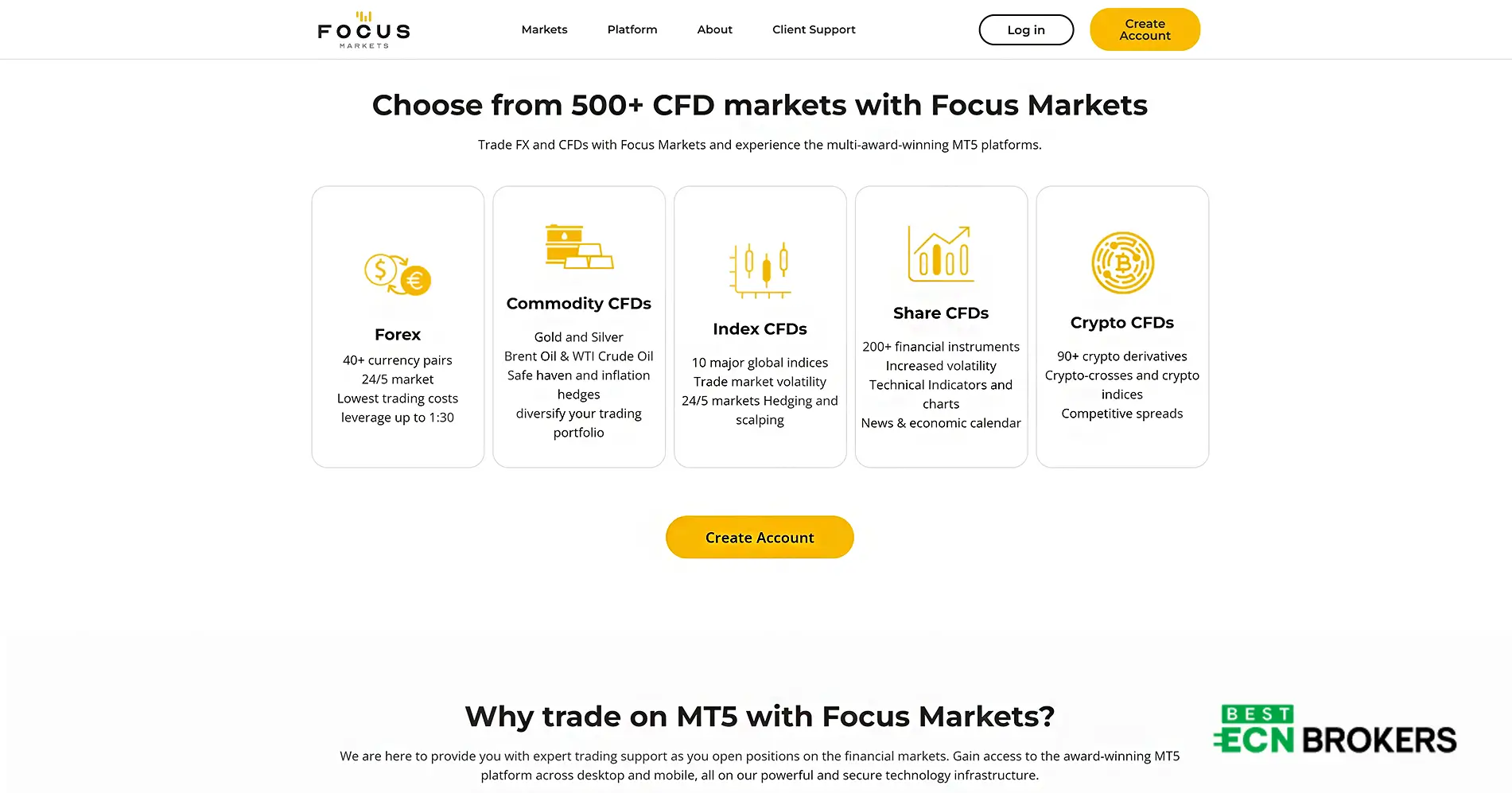
Forex is at the core. You get the usual majors like EUR/USD, GBP/USD, and USD/JPY, plus a decent list of minors and exotics. Spreads on the Raw account can be very tight, especially during liquid hours. For traders who like currency diversification, the list here is solid.
Outside of forex, Focus Markets has CFDs on global indices, shares, commodities, and cryptocurrencies. Indices include big names like the S&P 500, NASDAQ, DAX, and Nikkei. Commodities include gold, silver, oil, and other common alternatives. The stock CFDs are from the US, European and Australian markets, which is good for the trader considering combining forex and equities. With crypto, you get major coins like Bitcoin, Ethereum and a couple more, but the selection is smaller compared to brokers that focus heavily on digital assets only.
The advantage of having all this in one place is flexibility. You can trade currencies during the London session, switch to US stocks later in the day, and even hold positions on gold or Bitcoin over the weekend.
Overall, Focus Markets covers enough ground to suit most trading styles. Variety is always beneficial and provides more opportunity to diversify beyond forex.
Trading Costs
Trading costs at Focus Markets depend on which account type you choose. The Standard Account builds everything into the spread. On this account, spreads usually start from around 1 pip on major pairs. There are no extra commissions, so it’s easier for beginners to understand what they’re paying.
The Raw Account is different. The spreads can go to practically zero in active market hours, but you also pay a small commission per trade. For high-volume traders or scalpers, this setup is often cheaper in the long run because the overall cost per trade is lower. It also gives a clearer view of market prices since spreads are thinner.
Swap fees apply if you hold positions overnight. These vary depending on the instrument, and like with most brokers, they can add up if you leave trades open for several days. Day traders won’t notice much, but swing traders should keep this in mind.
When it comes to deposits and withdrawals, Focus Markets doesn’t charge its own fees for most methods. However, you may still have fees from your bank or payment provider, which are outside of the control of the broker. Processing times are normal; debit/credit cards and wallets are always the fastest, and bank transfers are the slowest.
Overall, the cost structure is clear. Standard accounts keep things simple, while Raw accounts reward active traders with tighter pricing. There are no hidden extras beyond swaps and possible banking fees, which makes the broker competitive against others in its class.
Education and Research Tools
Education isn’t the strongest area for Focus Markets, but the broker does provide enough material to help new traders get started. On its website you’ll find guides that explain basic trading concepts, such as how forex works, what leverage means, and how to place trades on MT5. If you’re completely new, the content will help, but experienced traders won’t learn much from it.
Focus Markets also hosts occasional webinars and provides market commentary. Analysis typically includes the key forex pairs, commodities like gold and oil, and the significant events in the economic calendar. This can be beneficial for traders who wish to keep up to date quickly without the need to search through all the economic and financial news themselves. The analysis is not of depth but is of sufficient quality for day to day trading.
The broker also integrates standard MT5 tools, which include technical indicators, drawing tools, and automated strategy testing. These cover most research needs for traders who like to analyze charts on their own. Since everything runs through MT5, traders can also add custom indicators or use third-party signals if they want to go further.
Overall, Focus Markets does enough to support new clients, but education and research are not its headline features. Professional traders will likely use outside alternatives for more advanced research, but it is good enough for beginners who only need the basics and just a little market analysis.
Customer Support
Focus Markets offers support through live chat, email, and phone. In practice, live chat is the quickest way to get a reply. During the day, responses usually come in under a minute, though at quieter times it can take longer. Email replies are slower, often the next business day. Phone support is available, but most traders won’t use it unless it’s urgent.
The support team mainly works in English. That’s fine for most traders, but if you’re not confident in English, you may find it harder than with bigger brokers that offer multilingual desks. Still, the staff are knowledgeable. When you ask about spreads, leverage rules, or how to set something up on MT5, the answers are practical. It doesn’t feel like you’re just reading a script.
The downside is availability. This isn’t a 24/7 service. If you trade late at night or on weekends, you may be forced to wait. That may be a problem if you have an account or funding issue after hours.
Overall, the support is decent but not a highlight. It’s reliable enough for day-to-day help, but don’t expect round-the-clock, multilingual coverage like the biggest global brokers provide.
Who Should Trade with Focus Markets
If you’re just starting out, the Standard Account will probably feel the most comfortable. There’s no commission to worry about, and the spreads are easy to follow. You don’t need to deposit a big amount either, which makes it less risky for someone who’s still learning.
The Raw Account is aimed at the opposite crowd. If you’re an active trader, or you place a lot of orders every day, the near-zero spreads are attractive. Yes, there’s a commission on each trade, but the overall cost is often lower if you’re trading in size or scalping.
Another reason Focus Markets works for a wide audience is the variety of markets. Some people stick to forex, others like to move into indices, gold, or even crypto. Having everything on one platform helps.
So, who’s it really for? Beginners who want a safe, simple entry point, and more experienced traders who care about low costs and fast execution.
Final Verdict
Focus Markets hasn’t been around as long as some of the big global brokers, but it has managed to build a decent setup in a short time. The ASIC license is a strong point, it shows the broker is serious about being regulated. The VFSC license isn’t as strict, but it helps them reach clients outside Australia.
The two account choices keep things simple. Standard is easy for beginners, Raw is sharp enough for expert traders. Costs are competitive, especially if you’re trading often, and MT5 runs smoothly across devices. That said, education is thin, support doesn’t run 24/7, and some traders will always complain about the lack of MT4.
So, is it worth it? If you want a safe and easy broker with decent pricing and a solid platform, yes. Focus Markets won’t give you every extra feature, but it gets the basics right and for most traders, that’s what really matters.